
Convergence and Divergence - The Hidden Reason For Rising and Sinking Air
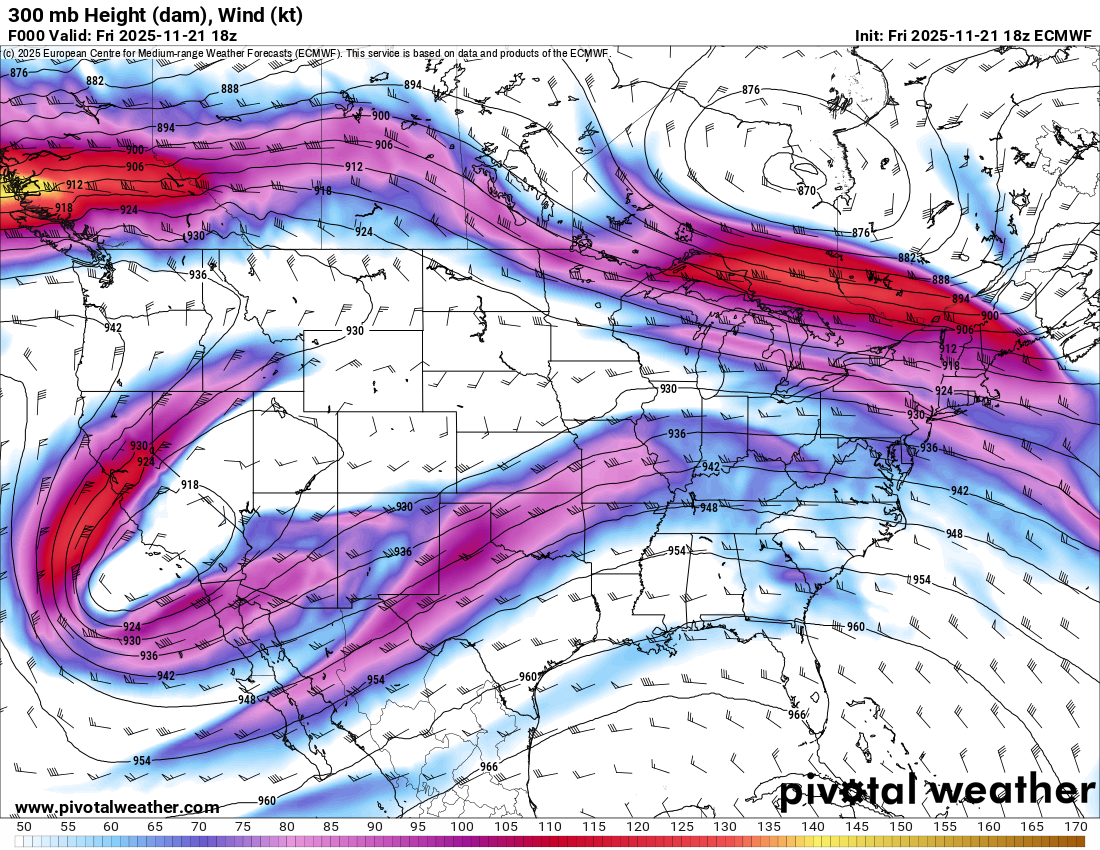
ECMWF 300 mb map used to identify areas of divergence and convergence. Image by Pivotal Weather
Bill - The Wx Learner - November 21, 2025
In my last post, I explained four of the main reasons air rises. Today I am going to break down one of those reasons, divergence and convergence. Once you see how convergence and divergence work, weather maps immediately become easier to interpret.
What Convergence Means
Convergence happens when air flows into a region faster than it can escape, the same way cars compress when traffic lanes narrow. As air piles up horizontally, the atmosphere has no choice but to respond vertically. The direction of that response depends entirely on where the convergence occurs.
Near the surface, convergence forces air to rise. That rising air cools and condenses, leading to clouds, precipitation, and the lift needed for storms. Surface convergence shows up along fronts, along shorelines where friction increases, inside low-pressure systems, or anywhere winds come together. Wherever air accumulates near the ground, upward motion develops because the atmosphere must make room for the extra mass.
Higher in the atmosphere, convergence produces the opposite effect. When air comes together aloft, it creates a surplus of mass above a given location. That extra mass presses downward, encouraging sinking air beneath it. The atmosphere constantly tries to stay balanced, so if air is added aloft, the column below responds by subsiding.
What Divergence Means
Divergence is the reverse situation: air spreads apart horizontally faster than new air is arriving. This creates a deficit of mass. Again, the atmosphere’s response depends on the level where divergence occurs.
At the surface, divergence causes sinking. Air spreading apart at ground level must be replaced by air from above, so the atmosphere moves the column downward. This is why surface divergence is associated with clearing conditions, higher pressure, and dry conditions.
Aloft, divergence has far greater influence. When air spreads apart in the mid or upper levels, it makes the column lighter This allows surface pressure to drop, and the deficit aloft pulls air up from below. Rising air can continue climbing more freely when it has space to go once it reaches higher altitudes. Jet streak entrance and exit regions are classic examples because they create strong upper level divergence. I’ll be covering this in a future post.
How Wind Speed Can Create Both
You may think that convergence and divergence depend on wind direction, but wind speed changes are just as important, and sometimes even more influential.
You can have convergence or divergence when the wind is blowing in a uniform direction. All it takes is a rapid change in wind speed as air moves into a region.
When wind slows, the air behind it continues moving quickly and begins piling up. That buildup is convergence.
The reverse happens when wind speeds increase, air spreads out which is divergence.
When Convergence Meets Divergence
The strongest lift in the atmosphere occurs when convergence at lower levels lines up with divergence aloft. When this happens, air is being forced upward from below while being pulled upward from above. The entire column becomes a conveyor belt. This is the structure behind many major storms, strong frontal systems, and long lived lake effect bands. Rising air is being removed so efficiently aloft that surface pressure drops quickly, which strengthens the system.
Why This Matters for Forecasting
Understanding convergence and divergence is a huge part of forecasting because it explains where air wants to rise or sink. You can often predict where storms will form by spotting where winds are slowing down, speeding up, or turning sharply. Once you see these patterns, you’re no longer just looking at weather maps, you’re interpreting them, and your forecasts become muchmore accurate.